The #1 Mistake First-Time Mini Excavator Owners Make (And It’s Not Maintenance)
You buy your first machine and immediately search for the biggest first-time mini excavator owners mistake. You watch maintenance videos. You change the oil on schedule. You grease the fittings every 8 hours. You think you did everything right to avoid a first-time mini excavator owners mistake. Then your machine breaks. You lose a week of work. You lose $3,000 in revenue.
The problem is not maintenance. The problem is transport and storage. First-time owners ignore these two areas entirely. They focus on the engine and hydraulics, completely forgetting how the machine gets to the job or where it sleeps at night. This guide shows you the real number one first-time mini excavator owners mistake. You get actionable fixes, real cost data, and the knowledge to avoid incredibly expensive failures.
You buy a single axle trailer rated for 3,500 pounds. Your mini excavator weighs 2,500 pounds. You think you are safe. This is a massive first-time mini excavator owners mistake.
The trailer must carry the machine weight plus attachment weight plus your tool weight. A 2,500-pound excavator with a bucket and auger weighs 3,100 pounds. You exceed your trailer rating by 400 pounds. Your trailer frame cracks. Your axle bends. You get pulled over, pay a $500 fine, and pay $1,200 for a new axle. Making this first-time mini excavator owners mistake causes instant financial damage.
Real data: A buyer in Florida made this exact first-time mini excavator owners mistake using a 3,500-pound trailer. The trailer failed after 2,000 miles. The axle snapped on the highway, flipping the machine. The damage cost $8,000, and insurance denied the claim due to overloading.
Your correct trailer setup:
- Dual axle trailer rated for 7,000 pounds minimum
- Trailer brakes on both axles
- Tie down rings rated for 5,000 pounds each
- Four grade-70 chains with binders
Another costly first-time mini excavator owners mistake is poor securing. You wrap one chain around each corner of the machine, attach to the trailer rings, and use a binder to tighten each chain. You pull the machine forward against the binders, add two ratchet straps across the tracks, and test each tie-down by physically shaking the machine.
A new owner skipped the ratchet straps—a classic first-time mini excavator owners mistake. His machine shifted. The chain rubbed against a hydraulic hose, causing it to fail. The machine lost all hydraulic fluid, and repair cost $1,400.
Do not commit this first-time mini excavator owners mistake: Never trust the machine’s parking brake for transport. Do not use nylon straps alone. Do not use a single chain. Use four chains minimum.
You finish your job and park next to your garage. Thinking it will be fine is a severe first-time mini excavator owners mistake. Rain falls, water sits on the control panel, and moisture seeps into the fuel tank through the cap vent. Water freezes overnight, your fuel gels, and your control board shorts out.
One operator in Michigan made this first-time mini excavator owners mistake by leaving his excavator outside for three months under a tarp. Moisture built up, the seat molded, electrical connections corroded, and the display screen failed. The repair cost $2,800.
Correct storage setup: Store indoors. If outdoors is required, use a breathable cover, elevate the tracks on wood planks, disconnect the battery, fill the fuel tank to prevent condensation, and cover the exhaust pipe. Indoor rental costs $150/month, but this prevents a $1,500/year first-time mini excavator owners mistake.
You back your trailer up to a hill, release the ramps, and drive the machine off. The ramp kicks out, and the machine drops three feet. You bend the blade cylinder and crack the track frame. This is an incredibly dangerous first-time mini excavator owners mistake.
A Texas operator made this first-time mini excavator owners mistake using worn 2,000-pound ramps for a 2,500-pound machine. The ramp bent, the machine fell, and broke his leg. Medical bills were $25,000; machine repair was $6,000.
Never make this first-time mini excavator owners mistake. Always park on level ground, use ramps rated for double your machine weight, secure them with pins, and lower the trailer jack to prevent tipping.
You load your machine and drive under a low bridge. You hear a crash. The cab hits the bridge, bending the ROPS. Ignoring vertical clearance is a completely preventable first-time mini excavator owners mistake.
A Pennsylvania driver made this first-time mini excavator owners mistake. His trailer and machine totaled 8 feet. An aftermarket light bar added 6 inches. The bridge was marked 9 feet but was actually 8’4″ due to resurfacing. He hit the bridge.
Avoid this first-time mini excavator owners mistake by knowing your exact height. Add the trailer deck height, machine height, 6 inches for hardware, and 4 inches for road variation. Put a height sticker on your dashboard.
Using an inadequate tow vehicle leads to another massive first-time mini excavator owners mistake. You own a half-ton pickup rated to tow 6,000 pounds. Your total load is 5,000 pounds. You think you are safe, but your transmission is not rated for repeated heavy towing.
A California owner committed this first-time mini excavator owners mistake by towing daily with a half-ton truck. The transmission failed at 40,000 miles, costing $5,000.
To avoid this first-time mini excavator owners mistake, use a three-quarter-ton truck minimum, keep tow-haul mode engaged, install a transmission cooler, and use a brake controller.
You park at a job site overnight, lock the cab, and take the key. Thinking it is safe is a devastating first-time mini excavator owners mistake. Thieves drag it onto a trailer in 90 seconds.
A Georgia contractor lost an $18,000 machine to this first-time mini excavator owners mistake. He had no GPS tracker or kill switch. It was never recovered.
Fix this first-time mini excavator owners mistake immediately: Hide a $150 GPS tracker, use a $200 track sprocket lock, and install a hidden battery disconnect switch.
- Day 1: Buy a 7,000-pound dual axle trailer with brakes to prevent the ultimate first-time mini excavator owners mistake.
- Day 2: Buy four grade-70 chains and binders.
- Day 3: Rent indoor storage space.
- Day 4: Install a GPS tracker and battery disconnect.
- Day 5: Measure your transport height and note it on the dash.
Let’s look at the average first-year loss if you make every first-time mini excavator owners mistake versus the cost to prevent them.
| Mistake / Prevention | Cost Impact |
|---|---|
| Trailer Failure Loss | $2,000 |
| Outdoor Storage Damage | $1,500 |
| Loading Accident Damage | $3,000 |
| Theft Loss (Post-Deductible) | $2,000 |
| Total Average Loss | $10,500 |
| Proper Trailer Upgrade | $1,000 |
| Indoor Storage (1 Year) | $1,800 |
| GPS and Heavy Locks | $400 |
| Total Prevention Cost | $3,200 |
You save $7,300 in your first year by not making a single first-time mini excavator owners mistake.
Maintenance matters. But transport and storage matter more. One first-time mini excavator owners mistake on the road costs more than 10 missed oil changes. One night of theft costs more than 100 grease fittings.
- Proper dual-axle trailer setup
- Four-point chain tie downs
- Level-ground loading procedures
- GPS tracking and kill switches
- Indoor or highly protected storage
- Using single-axle 3,500 lb trailers
- Towing daily with a half-ton pickup
- Trusting nylon straps for heavy iron
- Leaving the machine outside in rain/snow
- Loading on slopes or with worn ramps
Buy your mini excavator with confidence. Transport it with care. Store it with discipline. If you avoid every major first-time mini excavator owners mistake, your machine will last 5,000 hours, and your profits will increase.
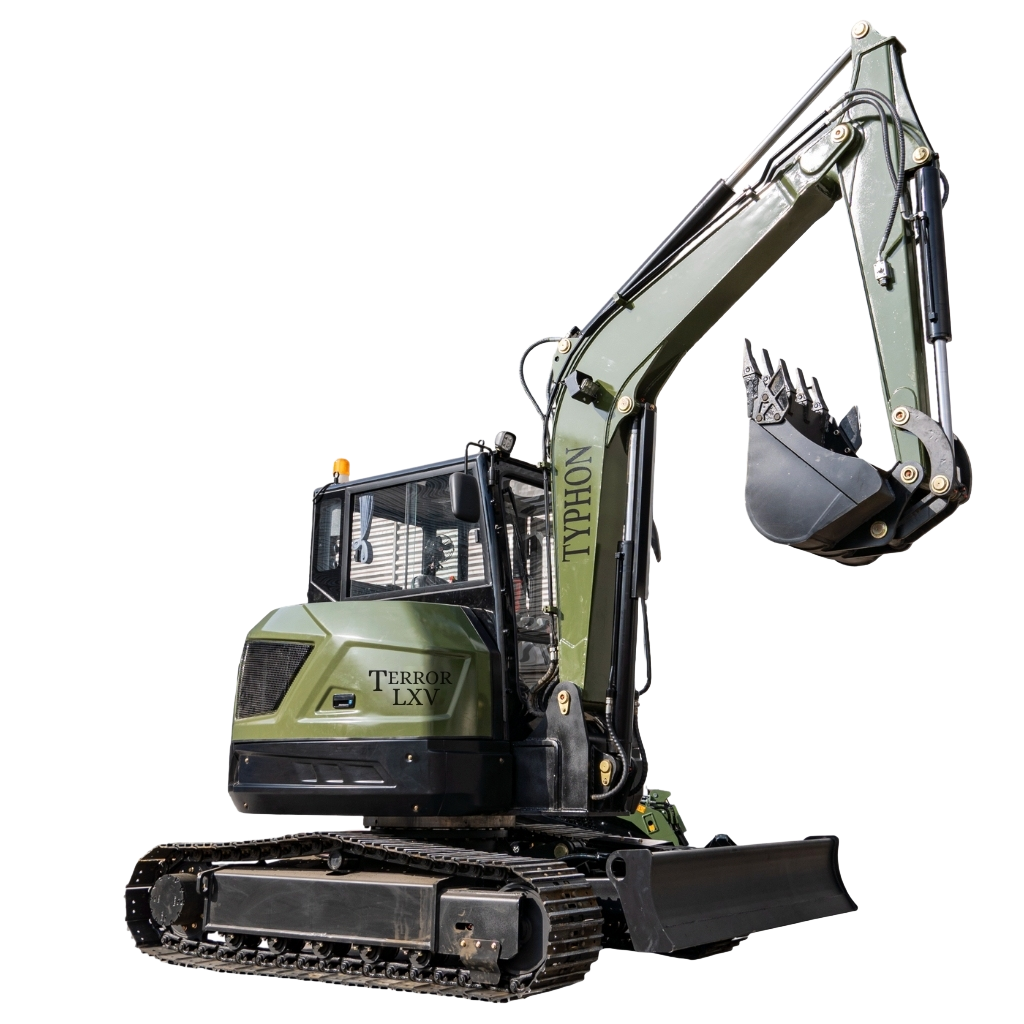
Now that you know how to transport and store equipment safely, invest in a machine built for serious work. The Typhon Terror LXV 6.6 Ton Excavator features a Kubota V2607 engine and full AC cabin.
View Equipment Specs →