7 Reasons a Mini Skid Steer Beats a Compact Tractor for Small Jobs
You stand in your equipment dealer lot. You see two machines. A mini skid steer. A compact tractor. Both cost similar money. Both look capable. You need the right choice for your small jobs.
This guide gives you seven reasons a mini skid steer beats compact tractor setups for small and medium projects. You get hard data. You get real use cases. You get a clear buying answer so you can invest confidently.
A compact tractor needs space to turn. A tractor with a front loader needs 12 to 15 feet just to complete a circle. You lose time backing up, and you reposition three times for one simple pickup.
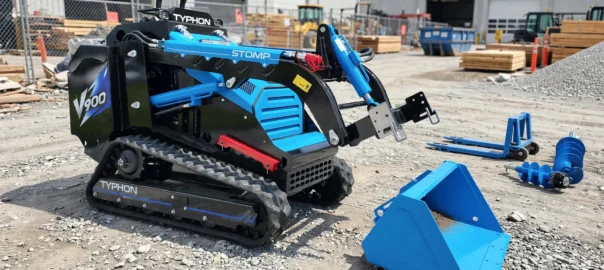
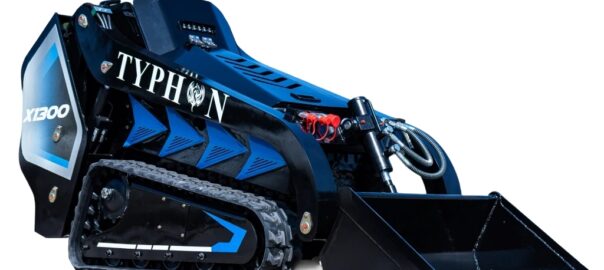
A mini skid steer uses true zero-turn capability. The machine spins inside its own length. For example, a Typhon Stomp X1300 turns 360 degrees in just 65 inches. You face the work directly, and you finish faster. This agility is the first reason a mini skid steer beats compact tractor models on residential sites.
Real data: A contractor timed both machines loading 10 tons of gravel into a pickup. The compact tractor took 45 minutes. The mini skid steer took 22 minutes. In speed alone, a mini skid steer beats compact tractor times by 23 minutes per job.
Your job site has trees. Your site has fences. Your site has tight corners. The mini skid steer fits. The compact tractor does not.
A compact tractor uses a three-point hitch. You need 5 to 10 minutes just to change an attachment. You line up pins, you adjust heavy arms, and you connect PTO shafts. You get greasy, and you get frustrated.
A mini skid steer uses a universal quick attach plate. You pull two levers, back out, drive to the next attachment, and pick it up. Total time is roughly 30 seconds. When you swap tools constantly, a mini skid steer beats compact tractor setups effortlessly.
A landscape contractor reported these numbers: He changes attachments eight times per day. At 8 minutes per change on a tractor, he spends 64 minutes purely on changes. At 1 minute per change on a mini skid steer, he spends 8 minutes. He saves 56 minutes each day, which goes directly to billable work.
A compact tractor weighs 2,500 to 4,000 pounds bare. Add a loader, a bucket, and wheel weights, and your tractor weighs 4,000 to 6,000 pounds. When you drive on finished lawns, you leave deep ruts, tear up sod, and make homeowners angry.
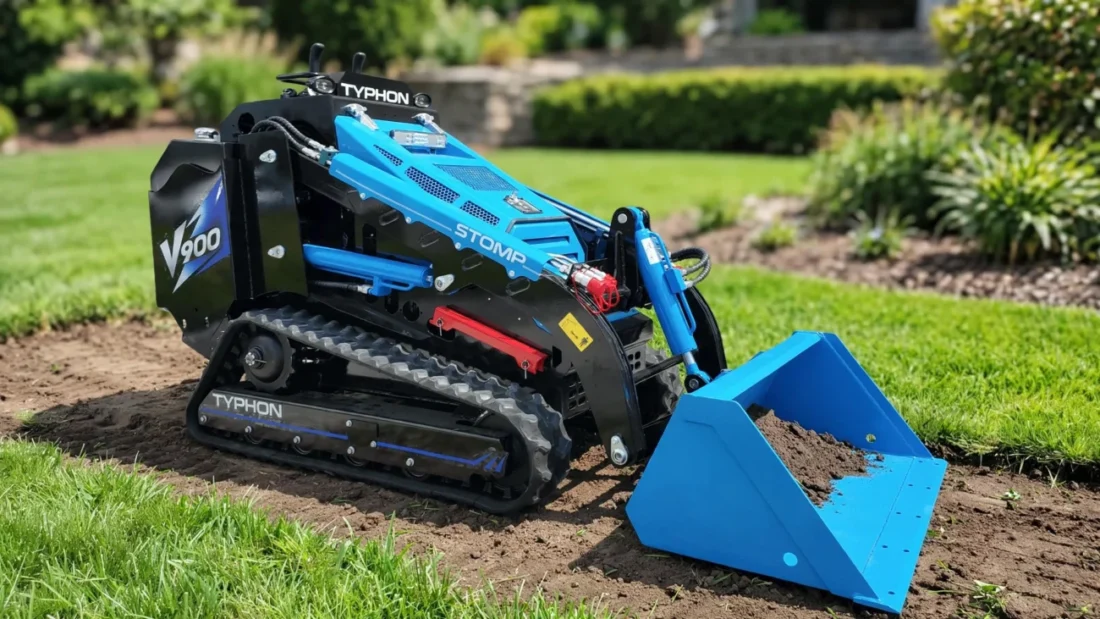
A mini skid steer weighs 1,500 to 3,000 pounds. The Typhon Stomp X1300 weighs just 2,200 pounds. The track pressure is 3.5 pounds per square inch. A human foot exerts 8 pounds per square inch. This means the mini skid steer damages the grass less than a walking person.
A property manager tested both. The compact tractor left 2-inch deep ruts after one pass. The mini skid steer left no visible marks after 20 passes. You keep your customers happy, and you avoid repair costs. Turf protection is a massive reason a mini skid steer beats compact tractor options.
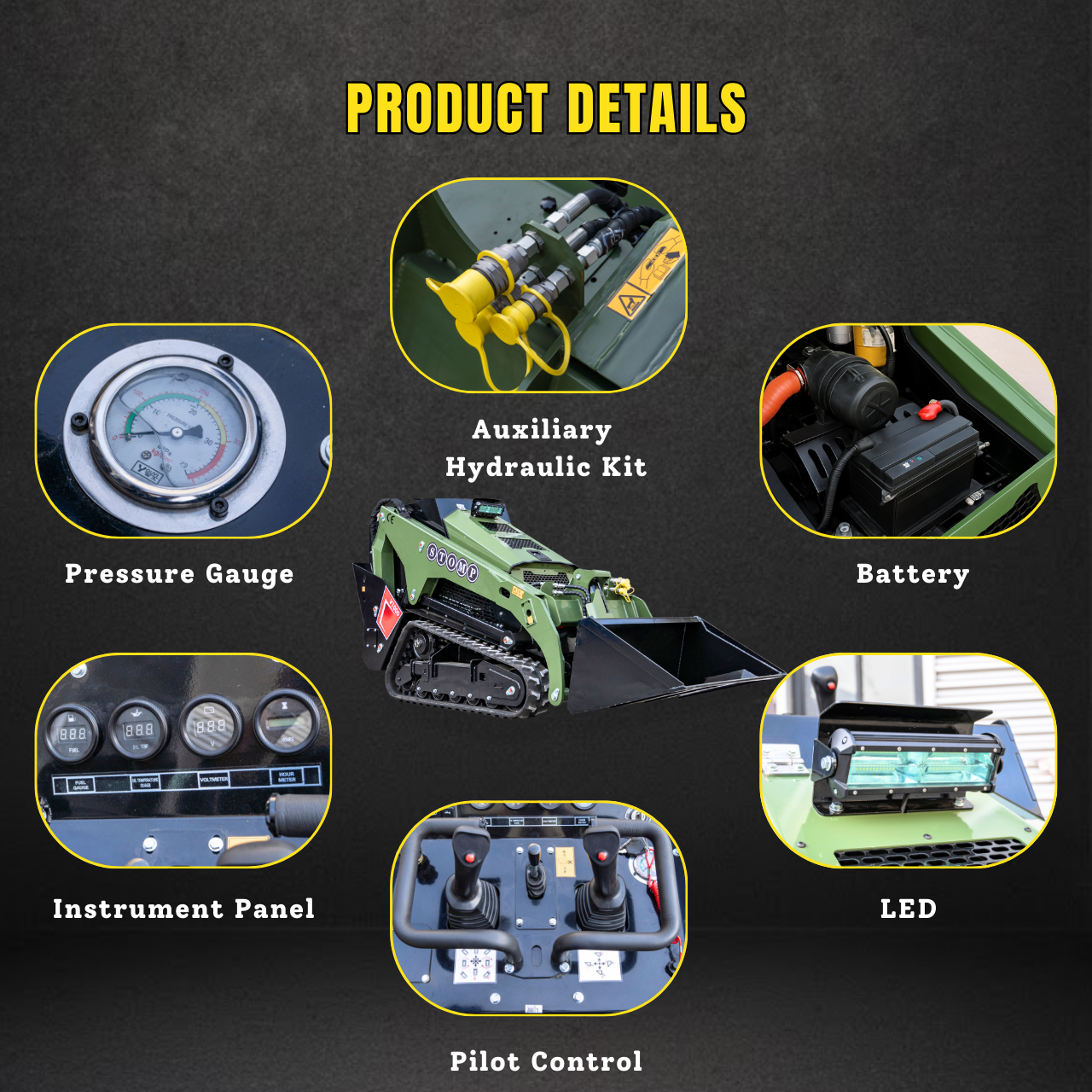
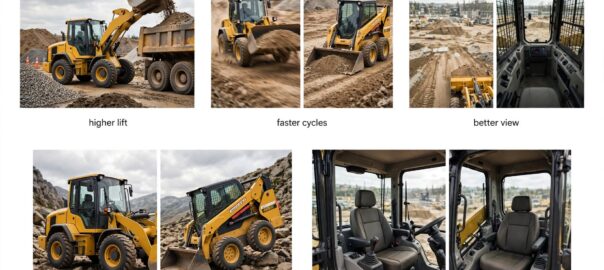
A standard compact tractor loader lifts to about 80 inches. When you try to load a dump truck, you struggle. You hit the tailgate, and you spill material all over the site.
A mini skid steer lifts to 90 to 110 inches. The Typhon Stomp X1300 lifts to 106 inches. You easily clear the truck side, load cleanly, and work much faster. When it comes to loading heights, a mini skid steer beats compact tractor loaders easily.
Compare the forward reach: A compact tractor reaches 24 inches forward at full height. You cannot place material over a fence, and you cannot feed a concrete mixer. A mini skid steer reaches 36 to 48 inches forward, letting you place material exactly where you need it.
Real numbers: A contractor built 50 feet of retaining wall. The compact tractor placed each block 24 inches from the wall, forcing workers to move each block manually twice. The mini skid steer placed each block directly on the wall. The job finished 4 hours faster.
A compact tractor uses limited, expensive attachments. You get a loader bucket, a box blade, a mower, or a backhoe. Each attachment costs $2,000 to $8,000. Many require a PTO, and many need extra hydraulic outlets.
A mini skid steer uses universal skid steer attachments. You can choose from over 100 options. Because of this universal fit, a mini skid steer beats compact tractor flexibility outright. You can easily rent attachments for $50 to $150 per day, or buy used attachments for $500 to $2,000.
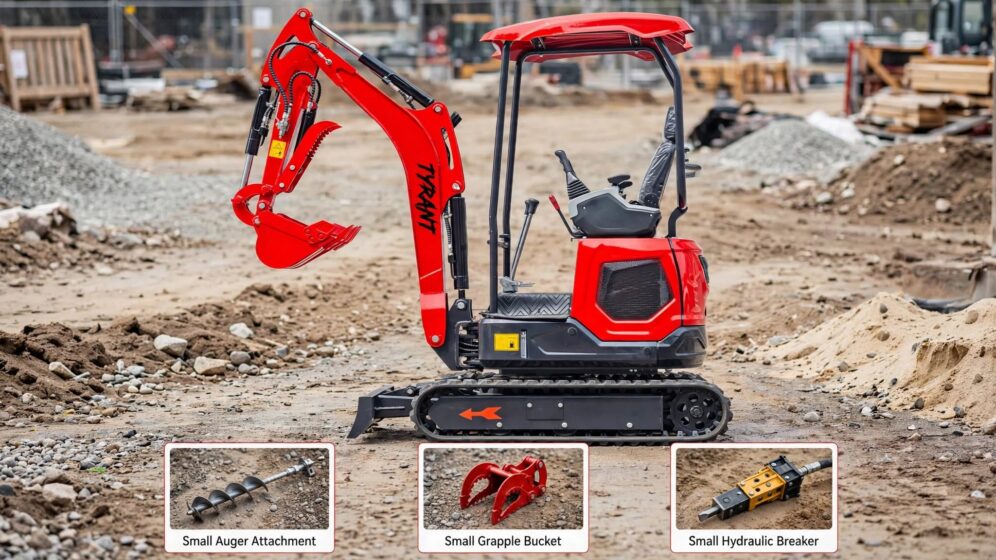
- Auger for digging fence posts
- Grapple for moving brush and trees
- Pallet forks for lifting materials
- Snow pusher for winter lot work
- Trenching bucket for utility lines
- Concrete mixer for small patio pours
- Hydraulic breaker for concrete demo
A compact tractor simply cannot run half of these attachments efficiently. The mini skid steer runs all of them.
A compact tractor weighs 4,000 pounds. You need a 10,000-pound GVWR trailer that costs $4,000 to $6,000. You also need a heavy-duty truck with a 7,500-pound towing capacity, which can cost $40,000 used.
A mini skid steer weighs around 2,200 pounds. You only need a 5,000-pound GVWR trailer that costs $1,500 to $2,500. Best of all, you can tow it with a standard half-ton pickup truck. Financially, a mini skid steer beats compact tractor towing setups by thousands.
| Setup Component | Compact Tractor | Mini Skid Steer |
|---|---|---|
| Machine Purchase | $25,000 | $15,000 |
| Required Trailer | $5,000 | $2,000 |
| Truck Upgrade Needed | $15,000 | $0 (Use current truck) |
| Total Transport Setup | $45,000 | $17,000 |
You save $28,000 outright. You use that money for attachments. You use it for marketing. You keep it as profit.
A compact tractor often has an open operator station. You sit completely exposed. A branch hits your face, a rock flies into your chest, or worse, you roll the tractor without proper roll cage protection on older models.
A mini skid steer has a roll cage standard. You stand or sit inside the heavy frame. The cage protects you from falling objects and tip-overs. The controls lock out immediately when you leave the platform. In safety, a mini skid steer beats compact tractor designs hands down.
OSHA data shows compact tractors cause 250 deaths per year in the United States, mostly from rollovers and PTO entanglements. Mini skid steers have no spinning PTOs and a much lower center of gravity.
Imagine you run a small landscaping business. You work 200 days per year and charge $75 per hour.
Compact tractor losses: You lose 45 minutes turning each day, and 56 minutes changing attachments. That is 101 minutes of lost time per day. At $75 an hour, you lose $126 per day in revenue, which equals $25,200 lost per year.
Mini skid steer efficiency: You lose 10 minutes turning and 8 minutes changing attachments. That is just 18 minutes lost per day. You only lose $22 per day in revenue, or $4,400 per year.
The Final Math: Your mini skid steer saves you $20,800 per year in lost time. It saves you $14,000 in upfront equipment costs, and $700 per year in fuel. Your total savings in year one is over $35,500.
A mini skid steer beats compact tractor models for small jobs, but the tractor still has its specific uses. You need a tractor for open field mowing, plowing a 5-acre garden, or pulling a hay baler. Buy a compact tractor if your property exceeds 5 acres or if you do row crop farming.
Buy a mini skid steer for literally everything else. Buy it for landscaping. Buy it for construction. Buy it for snow removal. Buy it for property maintenance under 5 acres.
- Tight backyard access and zero-turn agility
- Lightning-fast attachment swaps
- Protecting lawns from heavy ruts
- Lifting height and forward reach
- Lower transportation and trailer costs
- Massive open-field mowing
- Heavy agricultural row-crop tillage
- Running high-power PTO implements
- Pulling farm trailers and hay balers
- Maintaining properties over 5 acres
The numbers do not lie. A mini skid steer beats compact tractor efficiency for small jobs every single time. You save money. You save time. You save your lawn. You save your back. And you make more profit.
Ready to upgrade your workflow? Get the Typhon Stomp Mini Skid Steer powered by a Kubota D1105 Diesel EPA Engine. Built for tight spaces and massive productivity.
View Pricing & Specs →