5 Jobs Where a Skid Steer Wins Over a Compact Track Loader
You walk onto a job site. You see tracks everywhere and think you need them. You may be wrong, as in many situations, a skid steer wins over compact track loader setups.
Skid steers are older technology. They use wheels instead of tracks. They cost less to buy. They cost less to maintain. They move faster. They turn sharper. They are lighter to transport.
Compact track loaders definitely have a place. But they are not the answer for every job. Here are five specific jobs where a skid steer wins over compact track loader models.
You pour concrete pads. You lay asphalt driveways. You work on hard surfaces all day. Tracks leave distinct marks on fresh asphalt. Tracks pick up loose gravel. Tracks trap small stones in the tread pattern, dropping them exactly where you do not want them.
Wheels roll smoothly over pavement. They do not leave track marks. They do not pick up material and drop it elsewhere. They glide over hard surfaces with minimal resistance.
A skid steer travels significantly faster on pavement. Track loaders move at around 7 miles per hour. Skid steers move at over 11 miles per hour. This speed difference is exactly why a skid steer wins over compact track loader machines in paving. That speed difference adds up over a long day. You move between locations faster and deliver more loads per hour.
Paving contractors prefer skid steers. They work on roads, parking lots, and warehouse floors. The wheels protect the finished surface. The speed gets the job done faster, proving a skid steer wins over compact track loader production rates.
You load sand into dump trucks. You load gravel into trailers. You load debris into roll-off containers. Your work area is tight. You need to turn around quickly.
Skid steers turn in their own length. They rotate 360 degrees without moving forward. You face the truck, dump the bucket, spin around, face the pile, and repeat. Compact track loaders also turn in their own length, but tracks create more ground disturbance. Tracks tear up the surface during a sharp turn, forcing the operator to slow down to avoid damage. The cycle time dramatically increases.
Because wheels leave less damage during a turn, a skid steer wins over compact track loader efficiency in tight yards. The operator keeps speed up. The cycle time stays incredibly fast. Loading rates increase by 15 to 20 percent.
Yard work favors skid steers. The machine sits on hard compacted ground. The wheels grip well, and the turns are quick. The production rate is high. This is why a skid steer wins over compact track loader loading cycles.
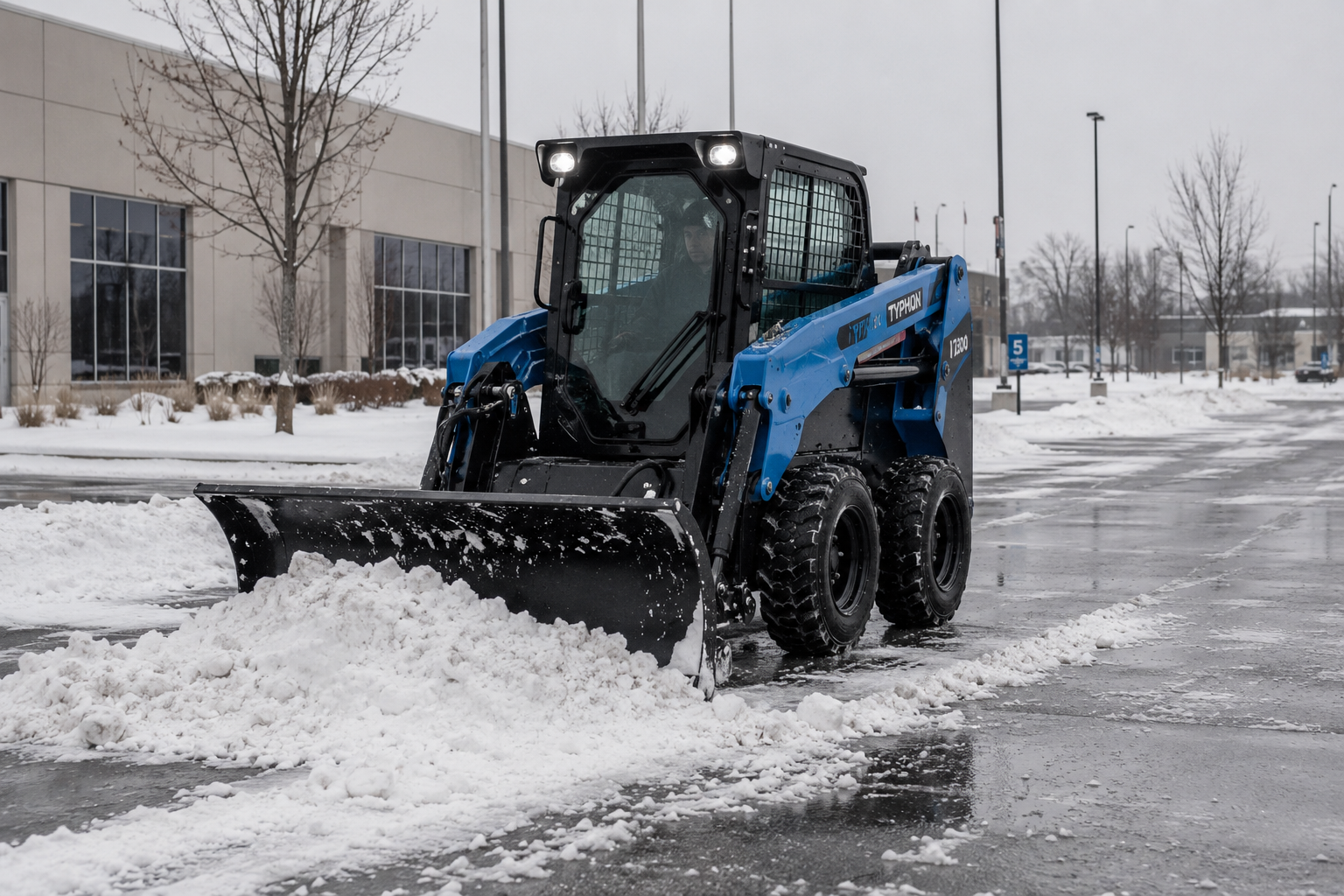
You push snow in parking lots. You clear driveways. You work on pavement all winter. Ice and snow cover the surface.
Tracks provide excellent traction in deep snow, but they also pick up ice chunks. The ice freezes in the track frame. The operator stops to break ice loose, which happens repeatedly during a storm.
Wheels shed ice much better. The tread pattern opens up, and the ice falls out as the tire rotates. The operator keeps moving without constant interruptions.
Skid steers push snow faster than track loaders. The wheels roll with less resistance, and the machine reaches full speed quickly. The operator clears more lots per hour. For winter speed on pavement, a skid steer wins over compact track loader clearing times.
Winter contractors prefer skid steers. They run for 12 hours during a brutal storm. They need speed. They need a machine that does not stop for ice buildup, which ensures a skid steer wins over compact track loader reliability.
You grade a building pad. You level a parking lot. You smooth a lawn area. Your work requires absolute precision. You need to place the bucket exactly where you want it.
Skid steers lift more weight heavily on the wheels. A wheeled machine with a 1,500-pound capacity lifts the same load as a track loader, but the wheels provide much more stability on hard ground. The machine sits firmly, and the operator controls the bucket with total confidence.
Track loaders ride on a suspension system. The tracks absorb bumps, but the machine bounces slightly. The operator must make constant micro-adjustments, making the final grade less accurate.
Fine grading demands precision. A difference of one inch matters. When fine grading hard dirt, a skid steer wins over compact track loader bounce. The wheels keep the machine completely still, allowing the operator to place material within a quarter inch.
Landscapers use skid steers for final grade. They lay topsoil, spread gravel, and prepare seedbeds. The results speak for themselves, showing how a skid steer wins over compact track loader precision.
You work on gravel all day. You move stone and crushed rock. You are never on pavement, and the ground is constantly loose and shifting.
Track loaders work beautifully in mud, but gravel is entirely different. Gravel gets caught in the track undercarriage. Small stones wedge tightly between the track and the sprocket, causing the undercarriage to wear incredibly quickly.
Wheels handle gravel far better. The tires shed stones as they rotate. The stones do not get trapped, and the undercarriage lasts significantly longer.
Skid steers also require less power to move on gravel. The wheels roll over the surface, and the machine does not have to push through the material. On loose stone, a skid steer wins over compact track loader fuel economy. Fuel consumption drops by 10 percent compared to tracks.
Quarry workers prefer skid steers. They move material all day on crushed stone. Quarry workers need a machine that lasts, which is why a skid steer wins over compact track loader durability.
You pay more for a compact track loader. A new CTL costs $2,000 to $5,000 more than an equivalent skid steer. You also pay drastically more for undercarriage maintenance. Track replacement costs $2,500 to $5,000 per set, whereas tires only cost $1,000 to $2,000 per set.
Track loaders have higher maintenance costs overall. The undercarriage parts wear quickly in abrasive conditions. Roller wheels fail, sprockets wear out, and track tension needs weekly adjustment. When you factor in these costs, a skid steer wins over compact track loader maintenance budgets.
Skid steers require far less undercarriage attention. Tires last longer in most applications. Tire replacement is cheaper, and tire repair is simpler. You can patch a tire on site, but you must replace a track in the shop.
The real cost difference adds up. A skid steer saves $8,000 to $10,000 on maintenance and repairs. Financially, a skid steer wins over compact track loader ownership costs over 2,000 hours.
Compact track loaders certainly have advantages. You choose a track loader for exceptionally soft ground. You use tracks in deep mud, heavy snow, or loose soil. If you work on a slope, tracks provide superior traction.
You choose a track loader for sensitive surfaces like finished lawns, as tracks distribute weight over a larger area so the machine does not sink.
You choose a track loader for heavy demolition where you work around sharp debris, as tracks resist punctures better than tires.
You choose a track loader for heavy push applications like pushing trees, brush, or massive piles of dirt.
But these conditions do not appear every single day. Your typical job involves moving material on hard ground. In these conditions, a skid steer wins over compact track loader capability.
Do not buy a compact track loader just because everyone else owns one. Consider your actual work, your job sites, and your budget.
The skid steer remains a highly capable machine. It loads faster and turns tighter. Operationally, a skid steer wins over compact track loader repair schedules.
Rent both machines for a week. Try the skid steer on your jobs, then try the track loader. Time your cycles, check your fuel consumption, and calculate your daily production.
The numbers will show you the answer and prove a skid steer wins over compact track loader profitability.
Many contractors return the track loader and keep the wheeled machine. Do not overlook the wheeled machine. In the most common jobs, a skid steer wins over compact track loader performance.
Look at your job schedule for the next month. Count the days you work on pavement. Count the days you work on gravel. Count the days you work in mud.
If pavement and gravel dominate your schedule, buy the skid steer. If mud and extremely loose soil dominate, buy the track loader.
This simple analysis saves you thousands and shows exactly when a skid steer wins over compact track loader investments. It saves you hours of maintenance and keeps your production incredibly high.
- Concrete and asphalt paving
- Loading trucks in tight yards
- Winter snow removal on hard pavement
- Fine grading and precision leveling
- Constant movement on gravel lots
- Deep mud and extremely loose soil
- Working on steep slopes or hills
- Protecting sensitive, finished lawns
- Heavy demolition with sharp debris
- Massive earth-pushing applications
The skid steer is not obsolete. It is a highly efficient tool that still performs at the top of its class. Use it exactly where it works best.
Ready to experience the speed and reliability of wheels? Check out the TYPHON Stomp V1000 Skid Steer powered by a Kubota D1105 water-cooled diesel engine with smooth pilot controls.
View Skid Steer Specs →