You plan a lift. You know the weight, the location, and you pick the crane. You think you are completely ready, but you might be wrong.
Understanding crane boom outreach changes everything. It determines what you can lift, where you can place the load, and if the lift is actually safe. Mastering this calculation is not optional; it is essential.
Here are five proven ways crane boom outreach affects your lift capacity and overall safety on the job site.
The horizontal distance from the slewing center to the load hook is critical. This specific distance, widely known as crane boom outreach, directly dictates how much weight you can safely lift.
The rule is simple: shorter distances mean more lifting capacity, while a longer crane boom outreach means less lifting capacity. The relationship is inverse and highly predictable.
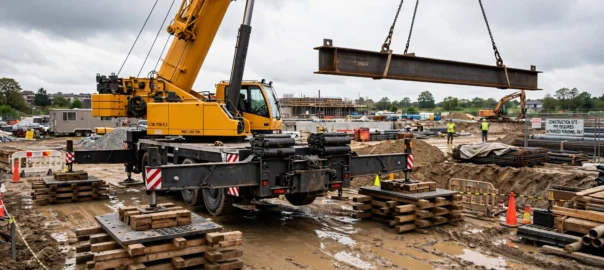
Consider a real example. A 100-tonne mobile crane lifts 100 tonnes at its absolute minimum reach. At a maximum outreach of 60 metres, the exact same crane lifts only 1.5 tonnes. The distance changes the crane’s capability entirely.
This principle applies universally to all cranes. Tower cranes, mobile cranes, and knuckle boom cranes all follow this ironclad rule. Your load chart shows the exact numbers for your specific machine.
Remember that crane boom outreach is not a fixed number. It changes dynamically as you move the boom up and down. The boom angle dictates the final horizontal distance.
When you raise the boom to a steeper angle, the outreach decreases, and your overall lift capacity increases. Conversely, lowering the boom to a flatter angle increases the crane boom outreach, causing your lift capacity to drop dangerously fast.
The Math: The calculation uses basic trigonometry. Outreach equals boom length multiplied by the cosine of the boom angle. For instance, a 40-metre boom at a 45-degree angle gives you 28.3 metres of reach. Raise the boom to 60 degrees, and your distance drops to 20 metres, increasing your capacity.
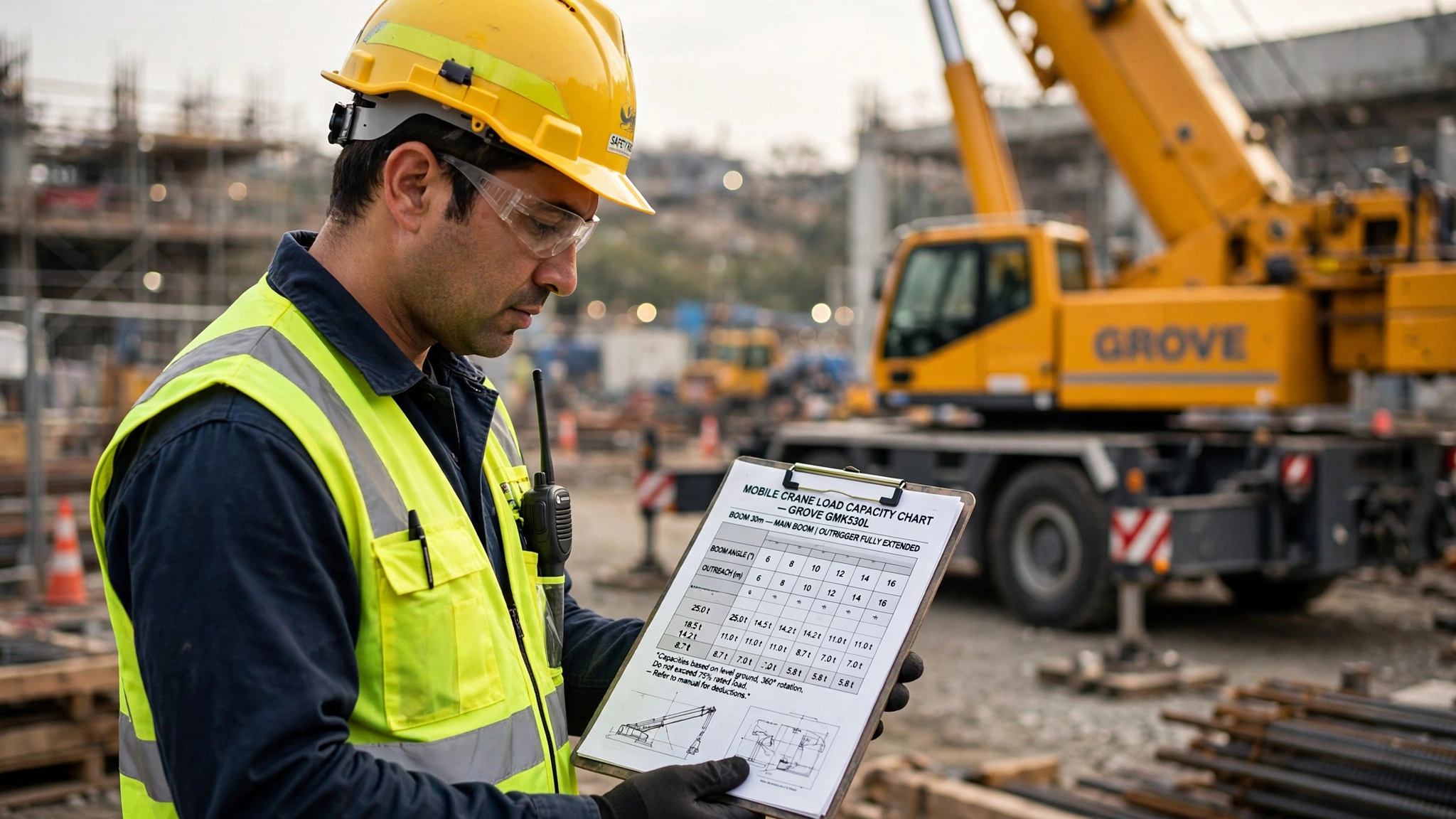
Every crane has a dedicated load chart showing the maximum capacity for each combination of crane boom outreach and boom angle. The chart is the final, legally binding authority.
The load chart accounts for multiple factors, including crane stability, structural strength, and hoist mechanism capacity. When you calculate your outreach, you must compare it instantly to the chart to ensure your load weight is safely below that limit.
An operator in Texas lifted a 10-tonne load at a 15-metre distance. The load chart showed a capacity of 11 tonnes. He was safe. Another operator lifted the same load at a 20-metre mark. The chart showed a capacity of 9 tonnes. He exceeded the chart, the crane tipped, and the site was severely damaged.
The crane boom outreach determines the moment acting on the crane. Moment is the load weight times the distance, which ultimately creates the overturning force.
A heavier load at a longer distance creates a much larger moment, making the crane completely unstable. Counterweights balance this moment, which is why manufacturers set strict limits on maximum crane boom outreach for pure safety.
Stability is also heavily affected by ground conditions. Soft ground reduces stability, while a level surface increases it. A crane operator placed a load safely at 20 metres on firm ground. On soft ground, the outriggers sank. He had to stop, place cribbing, level the crane, and retry.
Often called the working radius, the crane boom outreach limits exactly where you can place the load. You absolutely cannot place a load beyond the crane’s maximum outreach.
If you measure the distance from the crane to the placement point and it exceeds the crane’s capabilities, you cannot make the lift. You simply need a larger crane.
The distance also determines the swing clearance. The boom travels in a circle, and the radius of that circle is the reach itself. Obstacles within that circle become massive risks during a lift.
The calculation for this distance is straightforward. You only need two pieces of information: the boom length and the boom angle.
The formula is: Outreach = Boom Length x Cosine (Boom Angle).
Measure the angle from horizontal. A 0-degree angle is flat, while a 90-degree angle is perfectly vertical. If your boom is 30 metres long and the angle is 45 degrees, the cosine is 0.707. Multiply 30 by 0.707, and your exact crane boom outreach is 21.2 metres.
Measuring your outreach affects your daily work, your profits, and your safety. A company bidding on a job required placing beams at 40 metres. They used a crane with only 35 metres of maximum reach. They could not complete the job and lost the client.
Safety Warning: Incorrect distance estimation causes devastating accidents. Many tipping accidents are caused by exceeding the limit. Do not guess your crane boom outreach; calculate it accurately for every lift and never exceed 85% of your charted capacity.
Understand crane boom outreach. It is fundamental to safe lifting. Practice the calculation, measure angles, multiply lengths, and check charts before every single lift.
- Step 1: Measure the boom angle
- Step 2: Determine the full boom length
- Step 3: Find the cosine of the angle
- Step 4: Multiply length by the cosine
- Step 5: Check the load chart limits
- Step 6: Ensure load is below chart capacity
- Step 7: Add a 15% safety buffer to the lift
Train your operators to respect these limits. Plan every lift in advance and determine the precise distance before you even arrive on site. Ultimately, crane boom outreach is not a mystery—it is a simple, critical calculation that saves lives and secures profits.
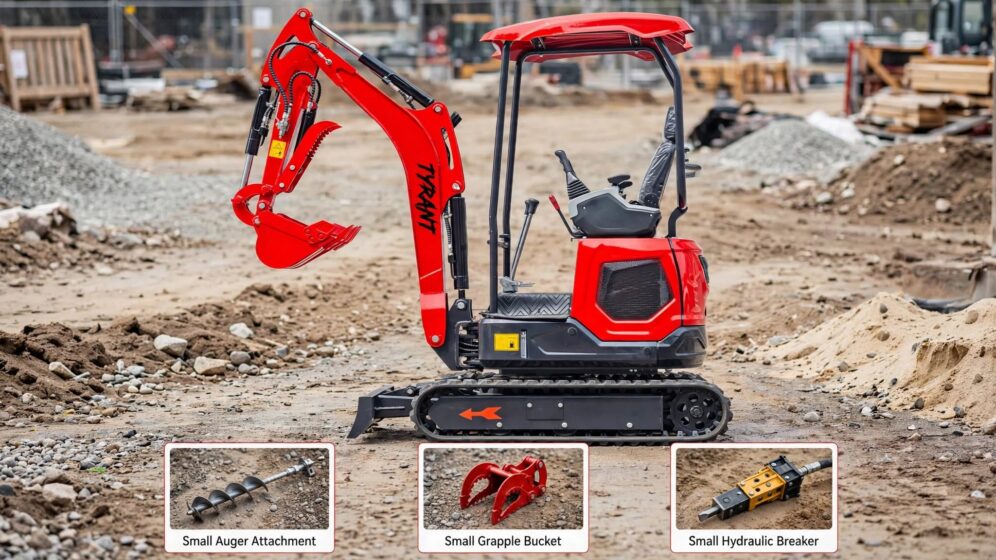
Looking for a highly capable machine with excellent lift capacity and stability? The Typhon Terror XVII Pro 3800 lbs Mini Excavator features a Kubota Diesel engine, a robust dozer blade, and a boom swing designed for maximum reach and stability.
View Excavator Specs →