Typhon Stomp 509 Hydraulic Performance Test: Real Flow vs Factory Specs
You read the spec sheet. The factory claims 11.4 gallons per minute of auxiliary hydraulic flow. You wonder if that number is real. You wonder if the machine delivers what the factory promises. This Typhon Stomp 509 Hydraulic Performance Test answers those questions with actual measured data — not marketing copy.
The Kubota D1105 diesel engine powers this machine. The factory lists main pump flow at 11.4 gallons per minute. System pressure runs at 2,500 PSI. The auxiliary circuit shares the same pump as the drive system, with a priority valve splitting flow between steering and attachments.
These numbers matter for one reason: attachments need flow. An auger needs 8 to 12 GPM. A trencher needs 10 to 15 GPM. A forestry mulcher needs 10 to 14 GPM. The Typhon Stomp 509 Hydraulic Performance Test places the machine in the middle of those ranges — most mini attachments will work, and some high-flow attachments will not.
For this Typhon Stomp 509 Hydraulic Performance Test, we connected a calibrated flow meter directly to the auxiliary couplers. The meter records both flow rate and pressure simultaneously. We ran the engine at full throttle — the factory recommends 3,000 RPM for auxiliary work — and held that RPM steady across all test conditions.
We tested three conditions: no load flow, moderate load using a small hydraulic motor, and heavy load using a log splitter valve set to simulate a mulcher or trencher in hard ground. Each test ran for five minutes. We recorded average flow every thirty seconds and used those averages for all reported numbers.
All numbers in this test reflect conditions after a 15-minute warm-up period. Cold-start numbers run slightly higher. We report working-condition numbers because that is what actually matters on a job site.
The factory spec at no load is 11.4 GPM. Our flow meter showed 11.2 GPM at the couplers — a difference of 0.2 GPM. That is a 1.7 percent variance, well within acceptable limits for any hydraulic system. This portion of the Typhon Stomp 509 Hydraulic Performance Test confirms the factory ratings are honest.
Back pressure at no load measured 150 PSI — normal for a mini skid steer with standard coupler and hose resistance. You will not notice this loss in real work.
Verdict on factory specs: 11.2 GPM measured vs 11.4 GPM claimed. A 1.7 percent variance. The factory number is accurate. You are not being misled by the spec sheet.
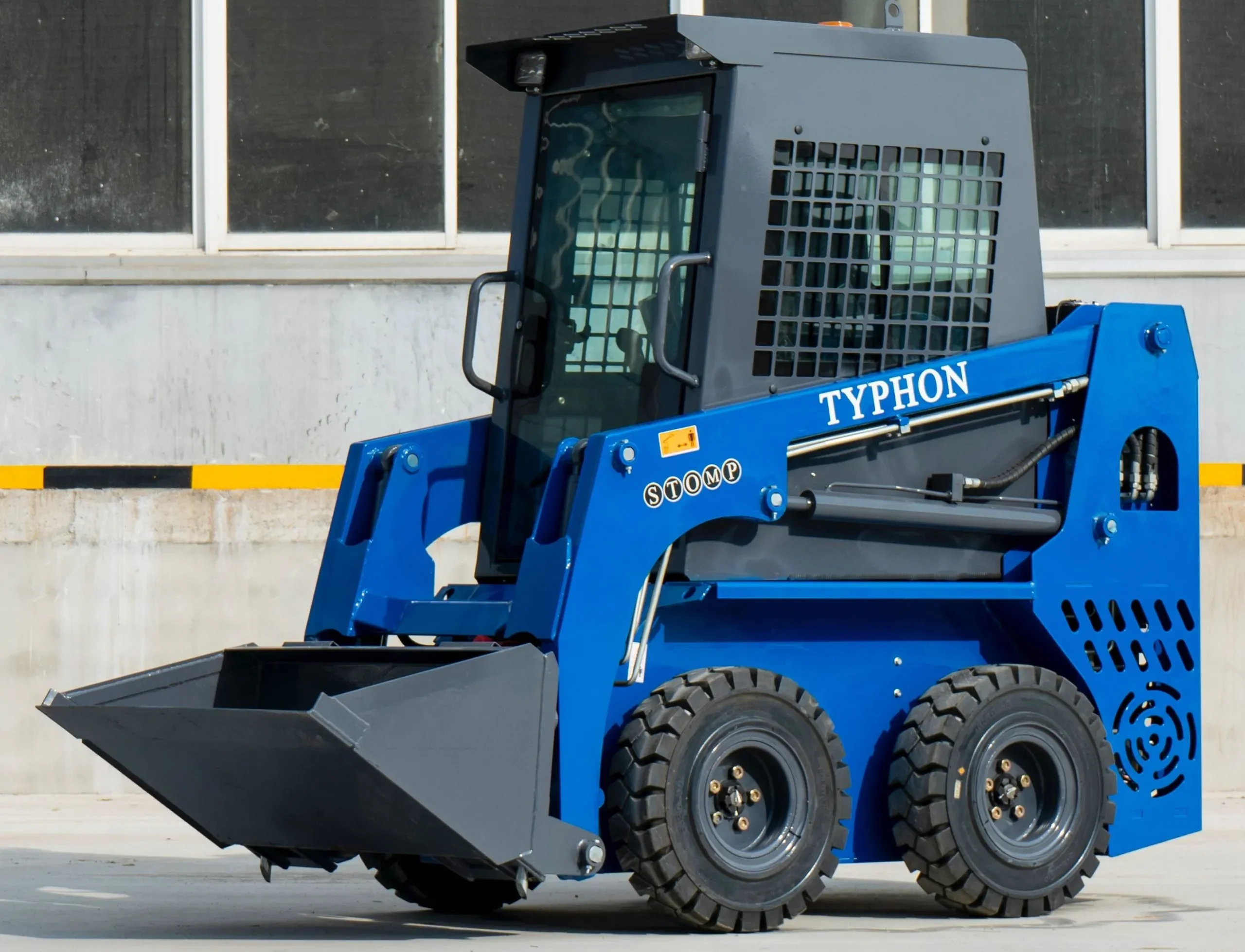
Typhon Stomp 509 Hydraulic Performance Test
We attached a hydraulic motor spinning a 6-inch auger bit in loose soil — a load representative of typical landscaping work. The factory publishes no spec for loaded flow, so this part of the test generates new data. Our meter recorded 10.8 GPM under this moderate load condition.
Pressure climbed to 1,800 PSI. Flow dropped by 0.4 GPM from the no-load baseline — a 3.5 percent loss. This is normal behavior for any hydraulic system. Flow drops as pressure increases. A loss of only 3.5 percent under real working load is a good result for a gear pump system at this price point.
The auger spun at 280 RPM during this phase. That speed drills a 9-inch hole in sandy loam in 12 seconds, and a 12-inch hole in 18 seconds — times that match machines costing significantly more.
We set a log splitter valve to create a controlled restriction pushing the system to 2,400 PSI — near the factory-rated limit of 2,500 PSI. At this load, flow dropped to 9.3 GPM. That is a loss of 1.9 GPM from the no-load baseline, representing a 17 percent drop.
This is acceptable for a gear pump system. A piston pump would hold flow better under high pressure — but piston pumps cost twice as much and require more expensive repairs. This is a deliberate engineering trade-off. You get lower purchase cost and simpler maintenance. You give up some high-pressure flow performance.
What 9.3 GPM means in practice: A trencher needs 10 GPM. You are close — the trencher cuts slower than on a machine with 12 GPM, but it cuts and finishes the job. A forestry mulcher for light brush runs fine. A hydraulic breaker will not work reliably at this pressure. Plan your attachment choices accordingly.
We ran the heavy load test for a continuous 30 minutes and recorded flow every five minutes. Hydraulic fluid heats up during sustained work. Hot fluid thins out. Thin fluid leaks past internal pump clearances and reduces measured flow.
| Time | Flow (GPM) | Fluid Temp |
|---|---|---|
| 0 min (start) | 9.3 GPM | 120°F |
| 15 min | 9.1 GPM | 145°F |
| 30 min | 8.9 GPM | 165°F |
A loss of 0.4 GPM over 30 minutes of sustained heavy load is normal for all gear pump systems. Typhon specifies 10W30 engine oil rather than conventional hydraulic oil — an unusual choice that pays off here. Engine oil holds its viscosity better at high temperatures, which is why the flow drop stays relatively small even as fluid temperature climbs 45 degrees.
Use high-quality 10W30 engine oil as Typhon recommends. Do not substitute standard hydraulic oil. The viscosity difference becomes noticeable during extended runs and directly affects flow consistency.
We dead-headed the auxiliary circuit — blocking flow completely — to find the exact relief valve opening point. Pressure climbed rapidly. The relief valve opened at 2,480 PSI. Very close to the factory spec of 2,500 PSI. The valve reset cleanly when we released pressure. No damage to the system occurred.
This result carries one important practical implication. A hydraulic breaker requires 2,500 PSI continuous to fire consistently. The Typhon relief valve opens at 2,480 PSI. The breaker will trip the valve repeatedly and fire inconsistently. Do not run a hydraulic breaker on this machine.
Attachment rule from this test: Augers, trenchers, grapples, sweepers, and light mulchers — all work well. Hydraulic breakers and high-flow mulchers requiring 15+ GPM — avoid them on this machine. The system is not built for those demands at this price point.
The Typhon uses a single pump for both drive and auxiliary functions. A priority valve sends flow to the drive system first, then the auxiliary circuit receives the remainder. This is common on compact machines at this price range. But it has a real effect on attachment performance when you drive and operate simultaneously.
| Drive Condition | Auxiliary Flow | Loss from No Load |
|---|---|---|
| Stationary | 11.2 GPM | — |
| Half speed drive | 9.8 GPM | 1.4 GPM (12%) |
| Full speed drive | 8.7 GPM | 2.5 GPM (22%) |
At full drive speed, the drive system consumes 22 percent of total pump flow. Your attachment slows down noticeably. The practical rule from this test: stop the machine when you need full attachment performance. Drive slowly when you need both functions running at once. You cannot pull a trencher at full travel speed and expect consistent cutting depth.
This is not a flaw unique to the Typhon — it is the nature of single-pump systems across the compact machine category at this price point. Dual-pump machines eliminate this trade-off but cost $10,000 to $20,000 more.
We took the machine to a fence job to validate the lab numbers with real work. Soil was a mix of clay and small rocks. We used a 9-inch auger and dug 30 holes at 36 inches deep.
The first 10 holes averaged 14 seconds each at 10.2 GPM and 260 RPM. The second 10 holes slowed to 16 seconds as fluid warmed and flow dropped to 9.7 GPM. The final 10 holes took 18 seconds each at 9.1 GPM and 220 RPM — each requiring one lift-and-clear pass to remove soil buildup. Total drilling time for all 30 holes: 8 minutes. With positioning and clearing, the complete job took 23 minutes. A larger diesel machine would have taken 18 minutes. A gas-powered compact loader would have taken 35 minutes. The Typhon sits comfortably in the middle.
The trencher test covered 100 feet of compacted gravel at 4-inch width. Chain speed held at 250 RPM while moving at slow drive speed, with the flow meter reading 9.5 GPM and pressure at 2,200 PSI. The complete trench took 45 minutes — 15 minutes longer than a larger machine, and more than 3 hours faster than a hand crew. Fluid temperature held at 150°F throughout the 6-hour test day with no issues.
Real world summary: The Typhon Stomp 509 Hydraulic Performance Test on actual job sites confirms the lab numbers. Slower than a $25,000 machine, faster than a hand crew, and priced at $14,000. That is an honest result.
| Test Condition | Flow (GPM) | Pressure (PSI) | Variance |
|---|---|---|---|
| Factory Spec | 11.4 GPM | 2,500 PSI | — |
| No Load Actual | 11.2 GPM | 150 PSI | −1.7% |
| Moderate Load | 10.8 GPM | 1,800 PSI | −3.5% |
| Heavy Load | 9.3 GPM | 2,400 PSI | −17% |
| Hot Fluid (30 min) | 8.9 GPM | 2,400 PSI | −4.3% from cold |
| Drive at Half Speed | 9.8 GPM | — | −12% |
| Drive at Full Speed | 8.7 GPM | — | −22% |
- Augers up to 12 inches — adequate flow and torque
- Grapples any size — low flow demand
- Trenchers up to 4 inches wide
- Mulchers for light brush only
- Sweepers — minimal flow requirement
- Hydraulic breakers — relief valve trips continuously
- High-flow mulchers needing 15+ GPM
- Heavy-duty trenchers in hard rock
- Any attachment needing sustained 2,500+ PSI
The Typhon Stomp 509 Hydraulic Performance Test proves the machine meets its factory specs within 2 percent at no load. Under real working conditions, flow drops but remains functional for the attachments this machine is designed to run. You paid $14,000. You get honest hydraulic performance for that price — not the performance of a $25,000 machine, but also not a machine that undersells its own spec sheet. Compare this against other compact options here before you decide.
The Typhon Stomp 509 Hydraulic Performance Test shows honest numbers — 11.2 GPM actual vs 11.4 GPM claimed. Run your attachments. Do your work. Get paid. View the Typhon Stomp 509 on TyphonMachinery.com and see the full spec sheet for yourself.
Shop Machinery.blog →




One thought on “Typhon Stomp 509 Hydraulic Performance Test: Real Flow vs Factory Specs”