How to Maintain Compact Machines and Avoid Costly Breakdowns
You buy compact machines. You want them to run for 5,000 hours. You want to sell them for a good price later. Maintenance decides both outcomes. Skip the schedule and you pay for it in pump failures, cracked frames, and machines that sell for parts. Follow it and your equipment runs long after your competitors have replaced theirs.
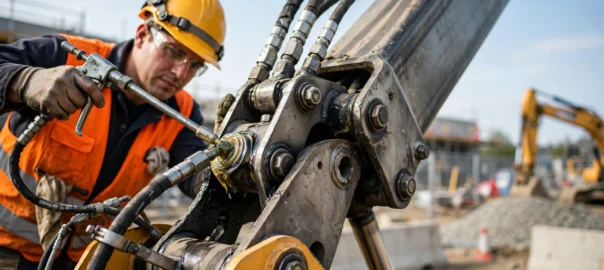
Grease is cheap. Parts are expensive. A $3 tube of grease saves a $500 pin and bushing set. Owners of compact machines who skip greasing pay for it in metal-on-metal wear that shows up quietly and fails loudly.
Grease every fitting every 8 hours — at the end of each working day. Do not skip a day because you feel tired. The machine does not get tired. Your neglect compounds faster than the hours do.
Focus on these points first: loader arm pivot pins, bucket linkage, attachment coupler, and undercarriage fittings on track machines. Pump old grease out until fresh grease pushes through. Wipe away the old grease. Dirt sticks to old grease. Dirt wears out your pins faster than any amount of hard work will.
A $3 grease tube every 8 hours costs you roughly $270 per year at daily use. A single pin and bushing replacement costs $500 minimum. The math is not close.
Walk around your equipment before you start it. Look for leaks on the ground. Look for drips under the engine. Look for wet spots on hoses. Compact machines that develop slow leaks overnight give you one chance to catch them before they become an emergency on a job site.
Check the engine oil — pull the dipstick, wipe it clean, push it back in, pull it again. The oil level should touch the full mark. Check the hydraulic oil at the sight glass or dipstick and keep it between the lines. Check the coolant level in the overflow tank and add a 50/50 mix of antifreeze and water if needed.
Do not trust the fuel gauge. Look in the tank directly. Running out of fuel damages your fuel system on diesel-powered compact machines — it pulls air and debris into the injectors and costs hundreds to fix what a full fuel can would have prevented.
Engine oil gets dirty. Dirt turns to sludge. Sludge clogs oil passages. Clogged passages destroy bearings. A $5,000 engine replacement starts with skipped oil changes — every time, without exception.
Drain the oil when the engine is warm. Warm oil flows faster and carries more dirt out with it. Replace the oil filter every single time — a $10 filter saves a $5,000 engine. Use the oil weight your manufacturer recommends. For most compact machines in most climates, 15W40 works. Confirm with your manual.
At 8 hours per day, you hit 250 hours in roughly 31 working days. Set a calendar reminder. Do not let it slide to 300 or 400 hours because the machine “seems fine.” It seems fine right up until it does not.
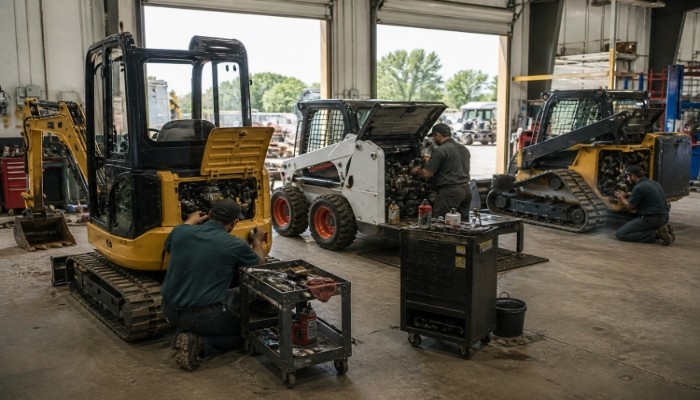
Compact Machines
Hydraulic oil powers every movement your equipment makes. Dirty oil wears out pumps. A new hydraulic pump costs $3,000 to $5,000 — more on larger compact machines with high-flow systems. That cost comes directly from skipping scheduled oil changes.
Change the hydraulic return filter every 500 hours. Change the main hydraulic oil at 1,000 hours. Use only manufacturer-spec oil — cheap oil ruins seals and costs you a pump replacement inside of a season.
Hydraulic system cost breakdown: Hydraulic oil change costs roughly $80 to $150 in materials. A pump replacement costs $3,000 to $5,000 plus labor. One skipped service interval can cost you 30 times the price of the oil itself.
Compact machines carry a hydraulic oil cooler and a radiator sitting next to each other. They collect dirt, grass clippings, and debris constantly. Blocked coolers cause overheating. Overheating shuts down your machine mid-job and damages seals and pumps if it happens repeatedly.
Spray water through the cooler from the fan side. Blow compressed air from the outside in. Do both — one pass alone does not fully clear packed debris. Repeat every 100 hours, or weekly during heavy dust and grass seasons.
A clean cooler runs all day. A blocked cooler shuts you down in the hottest part of the afternoon on your most important job. Clean it on your schedule, not the machine’s.
Vibration loosens bolts. Loose bolts cause cracks. Cracks cause failures. This sequence plays out on compact machines that work hard on uneven ground — which is every machine doing real work.
Check these bolts on a regular schedule: wheel lug nuts or track sprocket bolts, loader arm pivot bolts, cab mount bolts, and attachment plate bolts. Use a torque wrench and follow your manual’s specifications. Guessing a torque leaves bolts either loose or stretched — both cause problems.
Attachment plate bolts matter most. A loose attachment plate fails under load. When it goes, it takes whatever attachment you are running with it — and sometimes the operator’s confidence too. Torque these at every 200-hour check without skipping.
Rubber tracks wear out on all track-drive compact machines. A snapped track strands you on a job site and damages hoses and wiring underneath the machine when it goes. The tow bill and lost day add to the track cost you would have paid anyway.
Measure your track sag on flat ground. Check the gap between the track and the bottom roller. The manual gives you a specific range — 1 to 2 inches of sag is common across most track-drive equipment. Adjust tension with the bolt tensioner when it goes outside spec.
Replace tracks when lugs crack or when the rubber shows fabric underneath. A new track costs $1,200 to $2,000. A snapped track costs that plus a tow bill plus a lost revenue day. The math always favors planned replacement over emergency replacement.
Metal flexes under load. Flexing creates cracks. Small cracks grow into large cracks. Large cracks fail completely — usually under full load, on a slope, with a bucket full of material. Inspect compact machines for weld cracks at every 500-hour interval.
Use a flashlight and check these areas closely: loader arm welds, attachment plate welds, and the chassis around engine mounts. Mark any crack you find with a paint pen. Measure its length. Check it again in 50 hours. If the crack grows, call a welder immediately. If it holds the same size, monitor it closely.
A weld repair on a loader arm costs $200 to $400. A failed loader arm on a job site costs the repair plus downtime, towing, missed revenue, and a very uncomfortable conversation with your customer.
| Owner | Maintenance Habit | Hours at Failure | Total Repair Cost | Sale Price |
|---|---|---|---|---|
| Owner A | Full schedule followed | 4,000+ (no major failure) | $3,200 | $18,000 |
| Owner B | Skipped grease, oil, washing | 2,100 (engine), 2,300 (pump) | $12,000 | $3,000 (parts only) |
Owner A followed the full maintenance schedule on his compact machines for 4,000 hours. He replaced one set of tracks, two hydraulic hoses, and one battery. Total repair cost: $3,200. He sold the machine for $18,000.
Owner B greased every 40 hours instead of 8. He changed oil every 500 hours instead of 250. He never washed the machine. His engine failed at 2,100 hours. His hydraulic pump failed at 2,300 hours. Total repair cost: $12,000. He sold the machine for parts at $3,000.
The maintenance gap: Owner A spent roughly $3,200 in scheduled upkeep and sold for $18,000. Owner B spent $12,000 in emergency repairs and recovered $3,000. The difference between a well-maintained machine and a neglected one is $24,000 over the same ownership period.
- 5,000+ hour machine life
- Strong resale value at sale time
- Predictable repair costs per year
- No emergency breakdowns mid-job
- Engine and pump failures under 2,500 hours
- Parts-only sale price at the end
- $12,000+ in emergency repair bills
- Lost revenue days and tow costs
Print this list. Keep it in your machine. Every operator running compact machines on your fleet should follow it without exception. The schedule only works when it is consistent — one skipped week creates the gap that costs you later.
| Interval | Task |
|---|---|
| Every Day | Check all fluids — look for leaks under the machine |
| Every 8 Hours | Grease every fitting until fresh grease pushes through |
| Every Week | Wash the machine — drain the water separator |
| Every 100 Hours | Clean hydraulic cooler and radiator — check track tension |
| Every 200 Hours | Torque all major bolts to manufacturer spec |
| Every 250 Hours | Change engine oil and replace oil filter |
| Every 500 Hours | Change hydraulic return filter — inspect all welds for cracks |
| Every 1,000 Hours | Change full hydraulic oil — inspect drive belt and tracks |
Record every maintenance action in a notebook, phone app, or spreadsheet. Write the hour meter reading and what you did. These records increase your resale value by 15 to 20 percent. A buyer pays more for compact machines with documented history than for identical equipment with no records.
Storage tip: If your equipment sits for more than 30 days, start it monthly. Run it until the temperature gauge moves. Cycle the loader arms and attachment coupler. This circulates oil, charges the battery, and keeps seals soft. A sitting machine breaks faster than a working one.
Proper maintenance keeps compact machines earning for 5,000 hours and selling for strong prices when you are ready to upgrade. See how the right attachments extend what your machine can earn — and browse the full equipment lineup at Machinery.blog.
Shop Machinery.blog →

One thought on “How to Maintain Compact Machines and Avoid Costly Breakdowns”