Skid Steer Attachments Guide: One Machine, 10 Jobs
Buying a new machine for every job is not a business strategy. It is a fast way to overextend your budget. Attachments solve that problem. One base machine paired with the right attachments covers work that would otherwise require five separate pieces of equipment. Here are the ten attachments worth knowing.
This guide covers skid steers and compact track loaders because they run the widest range of attachments of any equipment category. The same attachment principles apply to mini excavators, which share several attachment types.
The standard bucket attachment ships with most machines. It digs, scoops, and moves loose material. Bucket capacity on compact machines ranges from 0.1 to 0.5 cubic yards, depending on model and configuration.
General-purpose buckets handle soil, gravel, and demolition debris. Heavy-duty rock buckets add reinforced cutting edges and stronger side plates for quarry work and rocky terrain. Light material buckets go wider with less structural weight for mulch, wood chips, and snow.
Match the bucket width to your machine’s rated operating capacity. Overloading tips the machine forward and wears the lift arms faster.
An auger attachment drills holes — post holes, tree planting holes, foundation piers, fence lines. The hydraulic motor on your machine drives a rotating bit into the ground. Bit diameters run from 4 inches to 48 inches.
A standard auger and one extension reach 10 feet on most compact machines. Add a second extension and you reach 16 feet. Hard ground and rocky soil need carbide-tipped teeth. Soft to medium soil runs fine on standard steel teeth.
Time comparison: One operator drills a post hole in under two minutes with the right auger setup. Manual post hole digging takes 15 to 30 minutes per hole. On a fence line with 80 posts, that difference is a full day of saved labour.
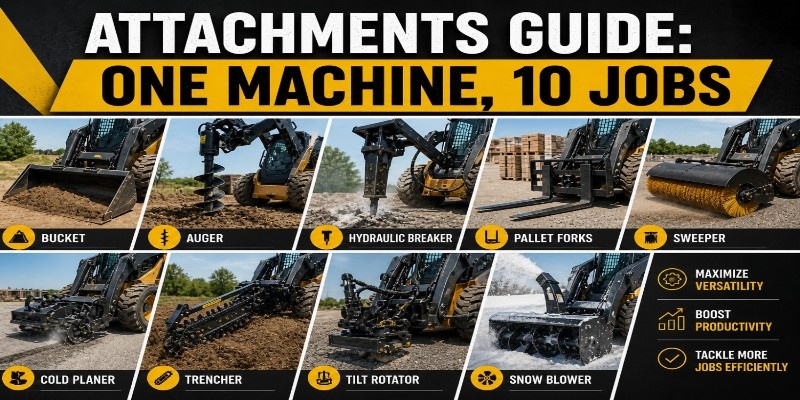
Concrete, asphalt, rock, and frozen ground all stop a bucket. A hydraulic breaker attachment does not stop. It delivers repeated impact blows to break hard material into pieces your bucket then removes.
Breakers are ranked by impact energy in foot-pounds or joules. Compact machine breakers range from 200 to 1,500 foot-pounds. Match breaker size to your machine’s hydraulic flow rating — an undersized hydraulic system running a large breaker damages both.
Renting a breaker attachment for periodic use makes more financial sense than buying one if your work demands it only a few times per year.
A grapple attachment grabs material and holds it. Where a bucket pushes and scoops, a grapple reaches, closes, and lifts. This matters when your material does not stay in a bucket.
Root grapples clear land after tree removal, sifting soil through the tines while holding roots, stumps, and brush. Demolition grapples grip irregular concrete pieces, twisted rebar, and mixed debris. Industrial grapples handle pipe, lumber, and scrap metal.
Who uses this attachment: Log and lumber yards, land clearing crews, and demolition contractors use grapples daily. It turns a loader into a sorting and handling machine — not just a pushing and scooping one.
Pallet fork attachments turn your compact machine into a rough-terrain forklift. Two steel tines slide under a pallet, your machine lifts, and you move the load across any surface a wheeled forklift cannot reach.
Fork capacity ratings matter. A set of forks rated at 4,000 lbs on a machine with a 2,500 lb rated operating capacity still limits you to 2,500 lbs. Your machine’s capacity is always the limiting factor — not the forks themselves.
Construction sites, nurseries, landscape supply yards, and agricultural operations all use pallet fork attachments regularly. If your work involves moving bagged goods, blocks, pavers, or palletized material, this attachment pays for itself quickly.
A rotary sweeper attachment spins a cylindrical brush at ground level. It cleans paved surfaces, pushes debris into windrows, and prepares sites for the next stage of work.
Angle broom attachments let you sweep material to one side rather than directly ahead. This works on road edges, parking lots, and areas where you need debris moved rather than just pushed forward.
Time saving: A sweeper attachment cleans a 50,000 square foot paved area in under two hours. Manual broom crews take all day on the same area.
A cold planer attachment mills asphalt and concrete surfaces. Rotating carbide teeth cut into the surface at a controlled depth, removing material and leaving a textured base for repaving.
Compact cold planer attachments mill widths from 12 to 24 inches. Depth control runs from surface skimming to 6 inches deep. Road repair crews use compact planers for patch work, utility cut repairs, and full-lane milling on residential streets.
Renting a full-size milling machine for small repair jobs is expensive and often unnecessary. A cold planer attachment on a skid steer handles the same work at a fraction of the cost.
A trencher attachment cuts a narrow channel into the ground for pipe, conduit, or cable. Chain trenchers use rotating cutting teeth on a straight chain and move through soil faster than an excavator bucket on narrow utility trenches.
Widths run from 4 to 18 inches on compact machine trencher attachments. Depth reaches 48 inches on most configurations. Utility contractors, irrigation installers, and electricians running underground conduit all use trenchers regularly.
Speed comparison: A chain trencher attachment cuts 100 feet of 12-inch deep trench in 20 minutes on moderate soil. Digging the same trench with an excavator bucket takes longer and leaves a wider disturbed area to backfill.
A tilt rotator attachment sits between your machine’s arm and the working attachment. It lets the attachment tilt side to side and rotate a full 360 degrees. This turns a standard excavator bucket into a precision grading and placement tool.
Operators grade slopes, lay pipe at precise angles, and place materials in positions that a fixed attachment cannot reach without repositioning the entire machine. Tilt rotator attachments reduce repositioning time significantly on detail grading work.
Adoption is highest in Scandinavia, where this attachment originated, but North American and Australian markets are adding tilt rotators steadily as operators see the time savings on grading and utility work.
A snow blower attachment throws snow to the side rather than pushing it forward. Where a bucket or blade builds snow piles, a blower clears the surface completely and throws material up to 30 feet away.
This matters in urban areas where snow storage space is limited. Sidewalks, parking structures, and tight commercial sites do not have room for large snow piles. Municipal contractors, commercial property managers, and airport ground crews run snow blower attachments on compact machines through winter.
The result: One machine with a snow blower attachment replaces what previously required a dedicated piece of seasonal equipment sitting unused for nine months of the year.
Before adding any attachment to your fleet, work through these three questions. Your answers will tell you whether to buy, rent, or skip entirely.
-
How often will you use it? An attachment used three times per year is a rental, not a purchase. Run the numbers before you commit to ownership.
-
Does your machine have the hydraulic capacity to run it? High-flow attachments like cold planers and snow blowers need machines fitted with high-flow hydraulic systems. Standard-flow machines cannot run them at full performance.
-
Does the coupler match your machine? Universal quick couplers fit most attachments — but not all. Confirm compatibility before ordering. A mismatched coupler means the attachment sits in your yard unused.
| Attachment | Best For | Buy or Rent? |
|---|---|---|
| Bucket | Daily digging and material moving | Buy — ships with machine |
| Auger | Post holes, tree planting, piers | Buy if 10+ jobs/yr |
| Hydraulic Breaker | Demolition, rock, frozen ground | Rent if under 5×/yr |
| Grapple | Land clearing, demolition, lumber | Buy if clearing is regular |
| Pallet Forks | Moving palletized material | Buy — pays back fast |
| Sweeper | Paved surface cleanup | Buy for regular site work |
| Cold Planer | Road repair, asphalt milling | Rent for occasional jobs |
| Trencher | Utility, irrigation, conduit runs | Buy if trenching is weekly |
| Tilt Rotator | Precision grading and placement | Buy for grading specialists |
| Snow Blower | Urban snow removal | Buy for winter contracts |
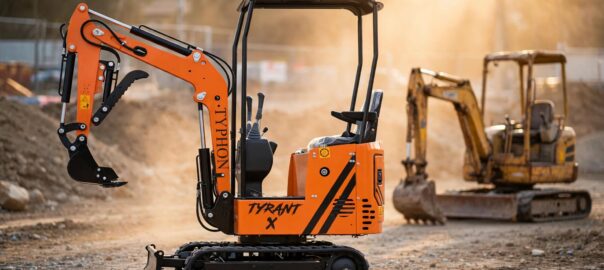
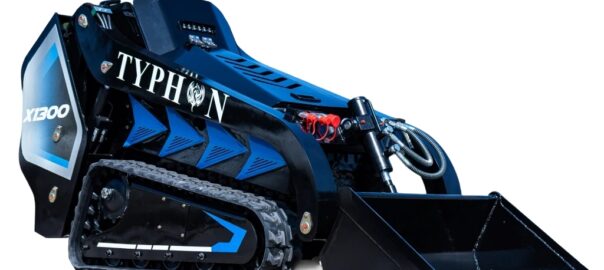
One machine with a planned attachments strategy covers more job types than three machines without one. See why the Typhon Stomp X1300 is built for attachment versatility — it runs the full range of attachments listed here.
Ready to build your attachments lineup? Browse compatible machines and attachments on Machinery.blog and find everything your base machine needs to cover more jobs.
Shop Machinery.blog →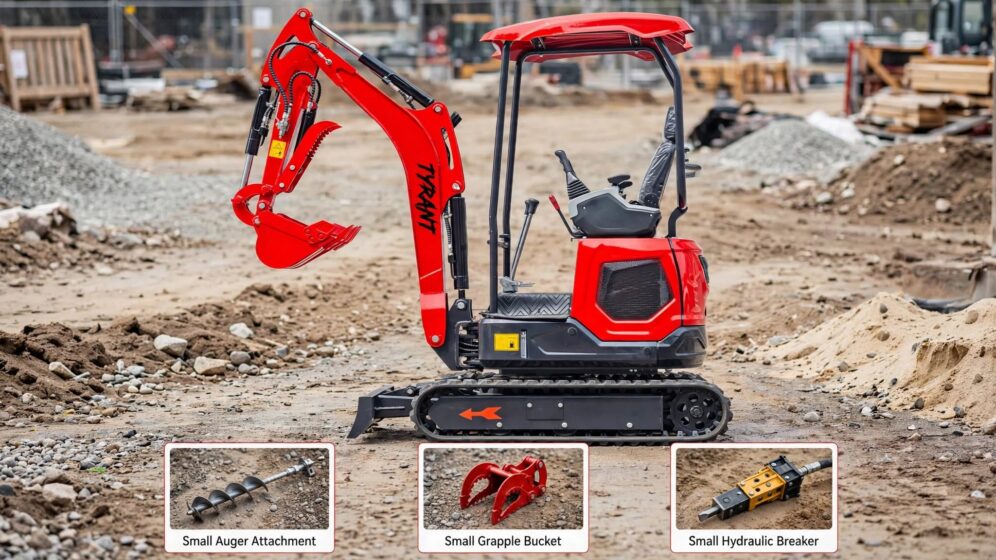
One thought on “Attachments Guide: One Machine, 10 Powerful Jobs”