Mini excavator undercarriage issues will start to show signs well before they cause any issues with the track. Recognizing early mini excavator undercarriage wear is vital for every machine owner.
These repairs can cost between $3,000 – $8,000 to fix. New tracks can be $2,500 – $5,000, worn sprockets can be $300 – $700, and worn idler wheels can cost $400 – $900. Preventing accelerated mini excavator undercarriage wear protects this heavy investment.
There are 7 key signs you can look out for which will tell you when your tracks will fail due to underlying mini excavator undercarriage wear. These are all very visible and will help you save money by identifying them early.
Tracks need to be tight so they stay on the rollers. If they are too loose they will slip and jump off the sprocket causing the machine to stop. Managing tension stops premature mini excavator undercarriage wear.
You should check the tracks every week. To do this, measure how much they are sagging in the middle. The manual will tell you what the correct amount is. Most mini excavators will need between 0.5-1″ of sag. If they are sagging more than this you need to tighten them. Use the adjuster valve to push more grease into the tension cylinder which will tighten the track. Then re-check the tension.
If they are sagging regularly there will be an issue, which accelerates mini excavator undercarriage wear. The tension cylinder is leaking and the seal has gone. The valve is stuck. Fix the cylinder before the tracks fall off.
The sprocket helps drive the track. The teeth on the sprocket engage with the track links. The teeth will wear down over time causing them to lose their grip on the track. This causes slippage and speeds up wear on the sprocket.
To keep on top of the issue and control mini excavator undercarriage wear, check every 100 hours. Look at the teeth on the sprocket. New teeth will have a flat top whereas worn teeth will be pointed and dig into the track link causing more wear.
If the teeth are pointed you need to replace the sprocket. This will cause damage to your tracks. The track links will dig into the valley of the sprocket. Replace early to stop severe mini excavator undercarriage wear on the entire system.
The idler wheels help guide the track. As the track moves the wheels spin. Over time the bearings will wear. If they become worn they will stop spinning causing the track to slide across causing the wheel to become flat. Monitoring mini excavator undercarriage wear means checking these wheels regularly.
Check every 100 hours. Spin the wheels by hand. They should spin smoothly. If they are grinding then the bearing is bad. If they are wobbly then the wheel is bent. If they are flat then they have stopped spinning.
Flat wheels cause a lump. This causes the track to jump over causing stress on the track which will cause cracking. Replace the idler wheel to prevent advanced mini excavator undercarriage wear.
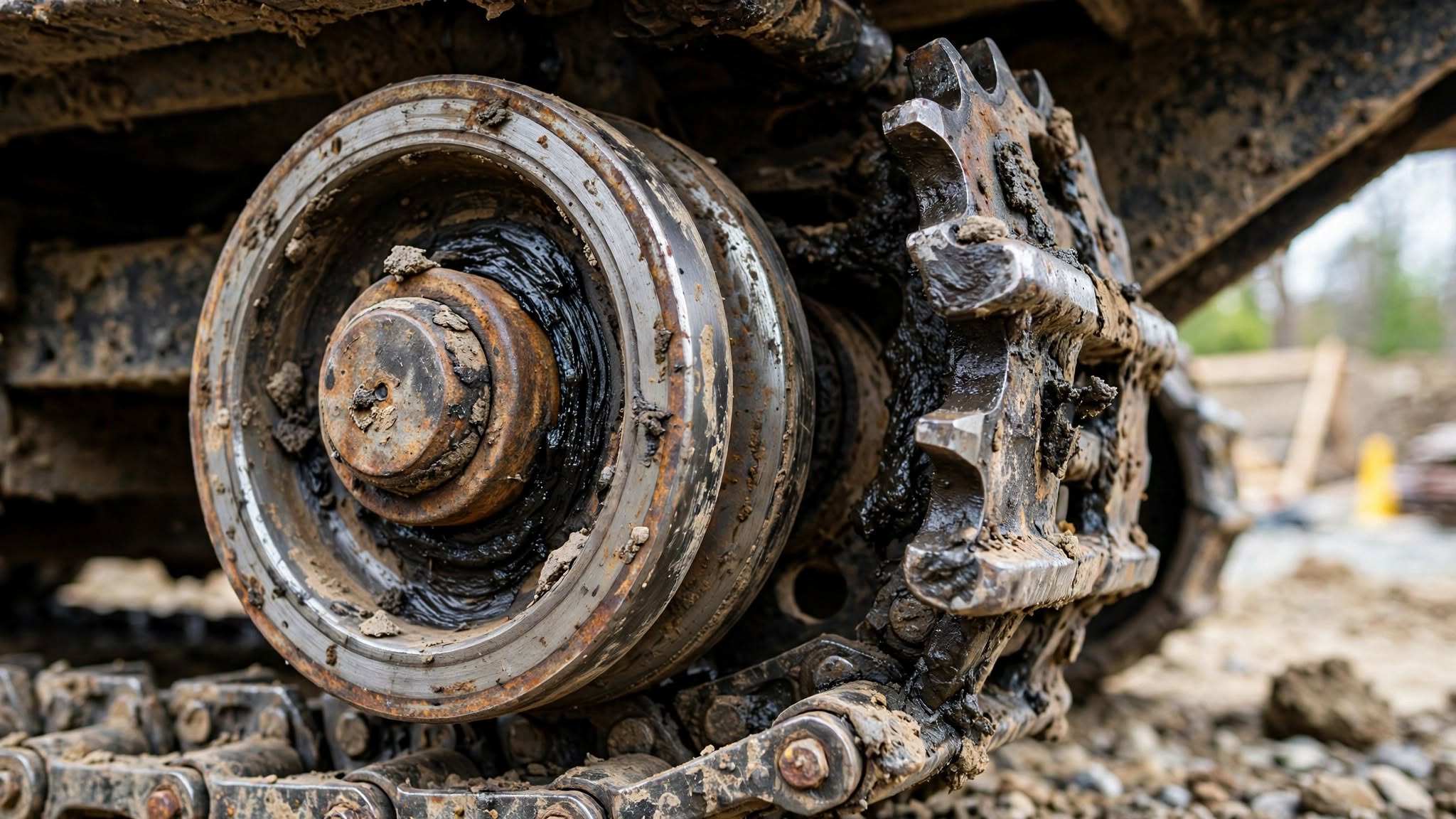
Track links connect the track shoes together. As the track moves they will flex. Over time they will wear causing cracks to appear where there is stress. Once the link cracks it will break and cause the track to separate. Tracking structural mini excavator undercarriage wear involves inspecting link edges closely.
Every 50 hours check the track links. Look at the edges of the links. Cracks will form on the corner. Small cracks will appear. If they crack they will fail suddenly.
Before checking make sure to clean the tracks. The cracks will be hidden by the mud. Use a pressure washer to clean them. Use a torch to identify the cracks. Paint mark any cracked links. Catching these cracks early is key to stopping mini excavator undercarriage wear.
The track shoes are in contact with the ground. As the machine moves they will wear. If they are wearing unevenly there is an issue. Spotting uneven signs of mini excavator undercarriage wear requires checking shoe height periodically.
If they are wearing on the outside then the track is not tracking properly. This could be due to the idler or sprocket not being in line. If they are wearing in the middle then the track tension is incorrect. If they are wearing on one side the machine is working on slopes. This is a classic symptom of uneven mini excavator undercarriage wear.
Every 200 hours check the height of the shoes. New shoes will have a certain height. Worn shoes will be shorter. Replace when they reach the wear limit. If the shoes are wearing unevenly turn them. Swap the left and right tracks to even out the wear.
The roller wheels help support the track. Inside the rollers there is grease to help lubricate the bearings. If the roller is leaking then the grease will escape causing the bearing to fail and the roller to stop moving. Catching grease leaks stops hidden mini excavator undercarriage wear.
Check every 50 hours. Look for any grease around the seals. If there is new grease then it is leaking. Replace the roller. If the roller fails it will cause damage to the track.
Before checking clean the rollers. The grease will be hidden by the mud. Wipe with a rag and use the torch to see the grease. Replacing rollers early minimizes overall mini excavator undercarriage wear. Rollers can be $200 – $500, whereas tracks cost much more.
A good track will run quietly. If the track is worn it will create noise. If it is grinding then there is metal on metal. If it is squealing then the bearing is dry. If it is clicking the track link is loose. Auditory warnings are a major sign of mini excavator undercarriage wear.
The operator will hear the noise whilst running. The noise will change over time. If there is a new noise then there is a new issue. Investigate the issue immediately.
Grinding equals worn sprocket. Squealing equals dry idler. Clicking equals loose track link.
The undercarriage will wear in a pattern. There are 7 signs you can look out for to predict track failure caused by mini excavator undercarriage wear: Track tension is loose, sprocket teeth are worn, idler wheels are flat, track links are cracked, track shoes are worn unevenly, roller wheels are leaking, and the track is making more noise.
- Check Track Tension: Weekly (5 mins)
- Check Sprockets & Idlers: Every 100 hrs
- Inspect Links & Rollers: Every 50 hrs
- Measure Track Shoes: Every 200 hrs
- Ignore issues: $3,000 to $8,000 in repairs
- Prevent early: Save thousands in downtime
- Max life: Up to 5,000 hours maintained
All of these signs are visible and will show early. By identifying the issues you can fix the problem and save your money. Checking your mini excavator undercarriage wear patterns weekly is non-negotiable.
A well-maintained undercarriage will last 5,000 hours. An undercarriage that is not looked after will fail after 2,000 hours. This could cost you thousands of dollars and cause massive downtime.
Get started today! Look at your tracks. Are they tight? Is the sprocket ok? The machine will tell you a story. Listen!
Looking for a durable, heavy-duty machine built for long-term undercarriage reliability? Check out the TYPHON Kuvuo 2.5 (Konstructz Series) featuring an EPA Kubota D1105 Diesel Engine and heavy-duty metal tracks.
View Excavator Specs →