7 Smart Ways Compact Equipment Technology Cuts Operator Training Time
You hire a new operator. You spend weeks training them. You lose immense productivity, pay for their initial mistakes, and constantly wish they could learn faster. It is a frustrating process.
Modern compact equipment technology is completely changing this dynamic. New machines now include features that drastically reduce training time. Operators learn faster, make far fewer mistakes, and become fully productive much sooner.
Here are seven smart ways compact equipment technology cuts operator training time and boosts your bottom line.
A new operator naturally struggles with grading. They cannot “feel” the grade yet, so they guess, overdig, underdig, and constantly correct themselves. They waste time.
Grade guidance systems in modern compact equipment technology solve this entirely. The system shows the bucket position on a screen using a simple colored display. Red means too high. Green means on grade. Blue means too low.
The operator moves the bucket until the screen simply shows green. They do not need to guess or rely on years of experience; they just follow the colors.
Real Result: A contractor trained two new operators. One used grade guidance; the other used traditional methods. The grade guidance operator finished a pad in 2 hours with zero rework. The traditional operator took 6 hours and required 3 hours of rework.
This single piece of compact equipment technology cuts training time from weeks to days. Operators learn by doing, see instant visual results, and understand grading mechanics much faster.
Digging a trench requires fine depth control. A new operator does not know the depth by feel, leading them to dig too deep or too shallow. They stop to measure constantly, losing massive amounts of time.
Dig assist is a breakthrough in compact equipment technology. The operator sets the target depth on the screen, and the system automatically stops the boom at the right depth. The operator digs perfectly consistent trenches without measuring.
They learn the digging process faster because they do not have to worry about depth. They focus entirely on smooth boom movement and mastering machine controls. They become productive in days instead of weeks.
Dig assist also helps with bucket angle. By setting and holding the angle automatically, this compact equipment technology teaches the operator the correct angle over time through muscle memory.
Each operator has different preferences. One likes fast swing speeds, while another likes slow. One prefers sensitive joysticks, while another wants them firm. A new operator usually wastes time adjusting the machine before every shift.
Operator profiles, an essential part of compact equipment technology, save these settings. The operator creates a profile, sets their preferred controls, and saves it. The next time they enter the cab, the machine adjusts automatically.
This compact equipment technology helps new operators start working immediately, keeping them focused on the job instead of setup.
Training Benefit: A trainer can set a specific profile for a new operator that limits machine functions. The operator learns at a safe, controlled speed. As they improve, the trainer adjusts the profile to unlock full power.
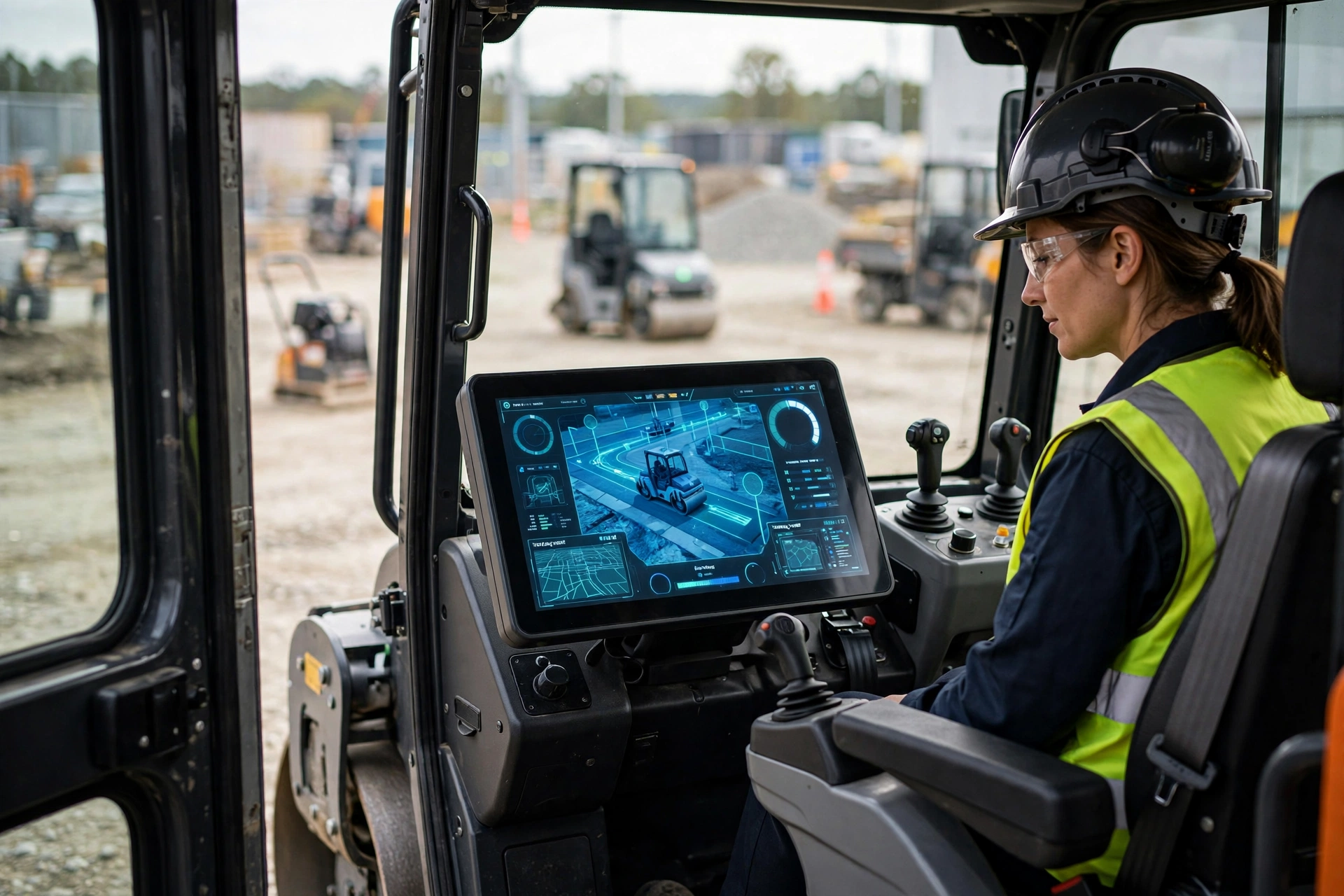
A new operator struggles with visibility. They cannot see behind the machine or check both sides easily. Because they worry about hitting objects, they move incredibly slowly and lose time.
360-degree cameras are a crucial compact equipment technology that solves this. Cameras on each side stitch together a full view of the surroundings on an in-cab screen. The operator sees everything, works confidently, and moves faster.
They learn the machine’s dimensions rapidly because they can visually confirm clearance on all sides. This compact equipment technology builds immense confidence, dropping training time significantly as operators understand machine behavior without the fear of causing damage.
You cannot be on every job site, and you cannot supervise every new operator. When new operators make mistakes, you usually do not see them and cannot correct them.
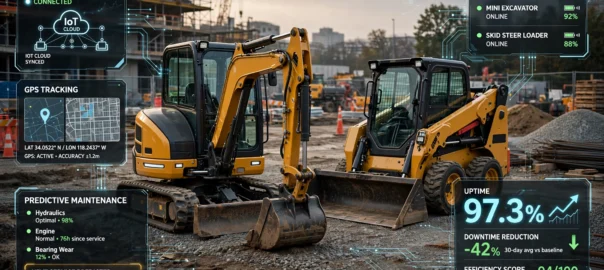
Telematics systems are a compact equipment technology that bridges this gap. The system sends data to your computer, showing machine hours, fuel usage, error codes, and operator behavior.
You can identify bad patterns—like overloading the machine or running at full throttle unnecessarily. Because of this compact equipment technology, you can send a message, explain the correct technique, and provide remote training without leaving the office. The operator changes behavior, and fuel consumption drops.
A new operator struggles heavily with repetitive tasks like loading trucks, grading pads, or digging footings. Each task has a steep learning curve.
Automated job functions within compact equipment technology simplify these tasks. You select the job type on the screen, and the system automatically adjusts boom speed, swing speed, and bucket angle.
The operator does not need to memorize complex settings. They simply follow the job profile and complete the task accurately, learning machine behavior over time. Features like auto-idle also teach the operator efficiency, proving how compact equipment technology acts as a silent instructor.
You cannot teach every skill on a physical job site. Some skills are too dangerous, require perfect conditions, or simply cost too much fuel to practice.
Virtual Reality (VR) is an emerging compact equipment technology that solves this. The operator wears a VR headset, enters a simulated job site, and operates a virtual machine that behaves exactly like the real one.
The operator learns controls without risk. They make mistakes, learn from them, and damage nothing. One contractor used VR training, and after 10 virtual hours, the new operator was comfortable and productive on the real machine by day one. Training time dropped by 80% using this compact equipment technology.
Training costs serious money. A new operator costs roughly $500 per day in lost productivity. If traditional training takes 30 days, that is $15,000 in lost productivity.
| Training Metric | Traditional Method | Technology Assisted |
|---|---|---|
| Days to Productivity | 30 Days | 10 Days |
| Lost Productivity Cost | $15,000 | $5,000 |
| Equipment Investment | $0 | $9,000 |
| Savings per Operator | $0 | $10,000 |
| ROI for 5 Operators/Year | – | $50,000 Saved |
With compact equipment technology, training takes just 10 days. The technology completely pays for itself. An investment of $9,000 in tech features yields a $50,000 return over a year by getting operators up to speed faster.
Talk to your dealer. Ask about these specific training features. Ask about grade guidance, dig assist, cameras, telematics, and VR training.
Test a machine with these features and run it with a brand-new operator. Time their training and measure their productivity. The difference compared to traditional training will be immediate and obvious.
The technology absolutely works, and the numbers are clear. Compact equipment technology cuts operator training time, helps them learn faster, and makes your business highly profitable, much sooner.
Ready to put modern technology to work? Explore our full lineup of excavators built to support advanced attachments and smart operations.
View Mini Excavators →